
Housework Time Use Diary Log
The Time Study is open!
I am looking forward to collecting hard data through weekly time studies to accurately estimate our housework time.
Directions for Use:
The Time Spent on Housework Diary Study is designed to track time spent on household tasks. Time spent on work, leisure, care for others, or personal care should be noted so the entire day is accounted for, but those categories do not require additional detail.
Step 1: Types of time documented on this log
Work – time spent working, preparing for work, or commuting to and from work.
Leisure – time spent playing, relaxing, or socializing.
Personal Care – enjoying meals, bathing/hygiene, or attending to medical needs.
Care for Others – time spent responsible for the care and well-being of children, elders, or others who cannot care for themselves.
Housework is defined as any task completed for the household. Please avoid grouping housework tasks into one broad category. Instead, think of this time log as a running list of completed tasks.
Ex: Gathered and sorted laundry. Researched new menu options. Placed an online grocery order.
You may list several tasks and types of work in each half-hour block. For example, cooking dinner and doing laundry. Or working and making a phone call to schedule a service.
Step 2: How to create a complete time log
Note of caution: Tracking work hours or caregiving activities may be easier than documenting and completing routine household tasks. Housework tasks are often completed while doing another type of work.
I found it helpful to pre-populate my time log for the week with the main types of work I had planned on my calendar (Calendar A). As you will see, I had predictable sleep and work time scheduled on my calendar before the week began. Each day and throughout the day, I made adjustments to my time log to reflect how my time was actually spent.
Calendar A – prepopulating planned week
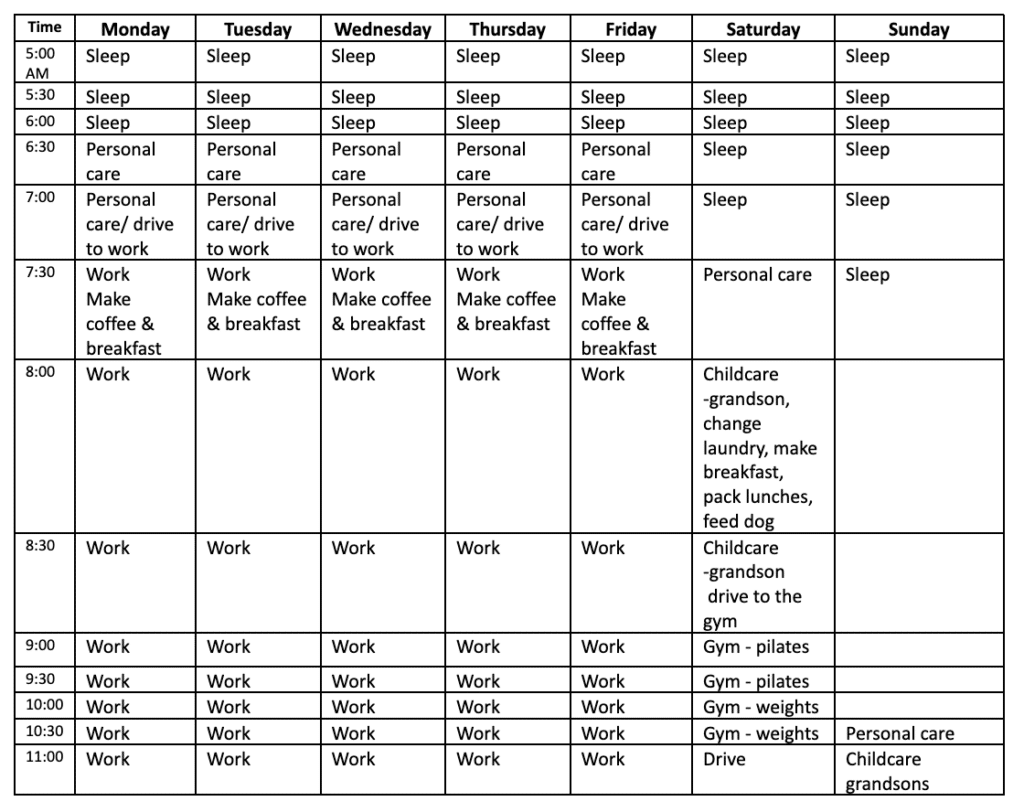
Note – you do NOT need to start your week on Monday. Please track 7 consecutive days, but you can start on any day of the week you would like.
By setting my time log up this way, I was able to log household tasks all day long (Calendar B).
Calendar B – editing log throughout the day to reflect housework tasks
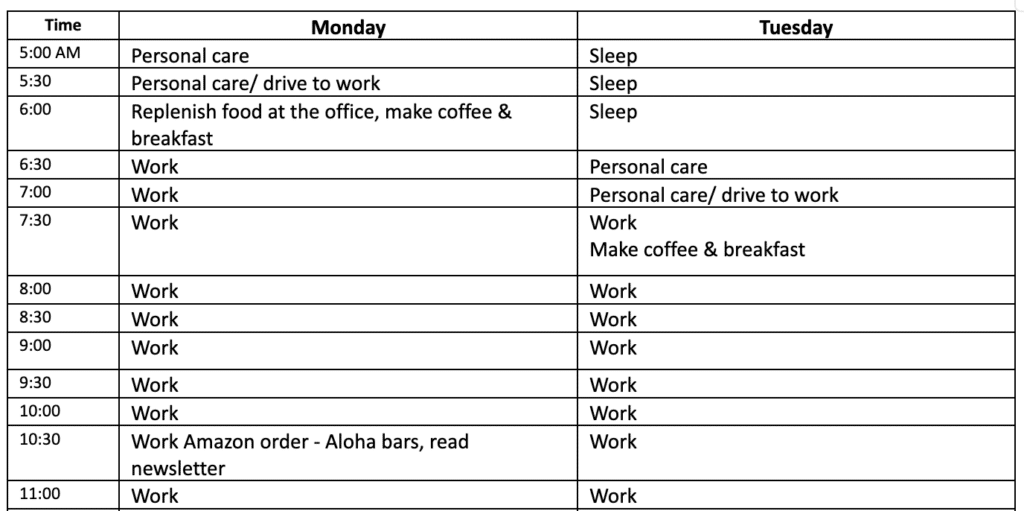
Remember, many household tasks are done automatically and will easily be missed in your time log if you are not intentionally looking for them. This log will capture both the task (doing laundry) and the process (collecting, sorting, washing, drying, folding, putting away).
Setting a timer can help you to remember and document the tasks you complete.
Feel free to color-code your log, write notes to me, and document your day in any way that is helpful.
Step 3: Use of time logs in Organize 365 research
Downloading this time log does not obligate you to participate in the Time Spent on Housework Diary Study that Organize 365 will be conducting.
When the study is open, you will be given the opportunity to submit your time log and answer research questions if you choose to participate.
Time logs submitted for the study will be used in three ways.
- You will be able to choose whether your log is used anonymously or whether I may know your identity.
- If I am able to learn your identity, I may contact you to discuss your documented week or to better understand your experiences through follow-up research.
- A longitudinal study may be conducted with the Time Spent on Housework Diary Study. Participants in the longitudinal study will be tracked by the Organize 365 Research team over time. Additional details will be disclosed when the study begins. Participants may opt out of the study at any time.
Therefore, please do not use family members’ names if you want to keep these private and choose to participate in either of the non-anonymous studies. For example, when documenting caregiving, I used “grandson” instead of my grandson’s name in my log.
Step 4: Optional data submission
At the bottom of the diary, there is a space for reflection about any activities or notes about the week you collect data for. If you want to provide any additional information, it will be used in exploratory qualitative research to identify new research questions for subsequent studies.
Finally, when you submit your diary, you will have the opportunity to grant permission for it to be published in its entirety in an academic journal, as a conference presentation, in a podcast episode, or in a book.
Thank you for your interest in the Time Spent on Housework Diary Study and Organize 365 Research.